Serverless – The New Option Of Reducing The IT Infrastructure Cost

The word serverless does not mean applications can run without a server. Every application requires CPU, Memory to run the program which is a process in execution. However, Serverless enables applications to share the resource’s availability in an optimal manner. Serverless imply applications that are written in a stateless container, ephemeral and managed by a third party. The Serverless was first started by the AWS in 2014 by the launch of AWS Lambda. There are three aspects to the serverless namely application/services. Infrastructure and architecture. Let us look at all the aspects of the serverless.

Why Serverless?

There are three fundamental reasons to go serverless as listed below.

1. Lower Operational Cost: This means fewer servers, fewer people to manage servers and there is a division of labour.

2. Faster time to Value: Usually applications or services require servers to be provisioned. With serverless, there are zero applications to be provisioned.

3. Focus on core value: Serverless means outsourcing our architecture and focusing on the core value.

Perspectives of Serverless:

1. Application/services perspective: Serverless is lightweight event-based microservices like Google functions. Google cloud functions are light weight event-based response functions that allow a small single-purpose function that allows a lightweight response without needing a server to be managed at any given point in time. Effectively any lightweight function that is not dependent on a server can be run on a serverless architecture.

2. Infrastructure for Serverless: The infrastructure for serverless is totally managed by the vendor. Like AWS lambda enables the serverless infrastructure. Scaling is done automatically, and it is triggered by events.

3. Architecture: The architecture is usually stateless function; event-driven and uses API gateway to as an input to get triggered. An example of a stateless function in a website is the addition of an item to a cart.


Serverless Offerings

Serverless offerings are being done both by the public cloud service providers and private cloud service providers. AWS offers Lambda service for serverless mode. AWS lambda is very popular, and the shift has happened to AWS cloud lambda based on the fit for purpose. Not every service can run on serverless but whatever is doing only focused on a single purpose and uses independently the Compute power then serverless becomes an option to be used. Like AWS, Microsoft Azure offers serverless compute as well. Google cloud provides cloud serverless to deploy and develop APIs in the form of Microservices. Serverless provides a new way of running an application as a FaaS. (Function as a Service).


Disadvantages of Serverless

1. Cold Starts: Sometimes cold starts take quite a lot of time say anywhere from 200ms-600ms.

2. Parallel Requests: Parallel requests are not allowed inside the code. Parallelism is an issue.

3. Coding Language: Need the language to support application development. Node.js supports the Serverless architecture and not python. It is best suited for background jobs, API calls, batch jobs etc.

4. Hidden costs: The right job must use the serverless as some of the cloud service providers charge based on the no of requests/usage of API gateway though the cost of the CPU. So, RAM will be less as the cost is being shared.

5. Code Maintenance: This is higher on serverless architecture.
The transformation to Serverless is worth doing considering the fact it leads to the huge cost savings available due to shared CPU and RAM cost. At the same time, the right application must be chosen to run the serverless.

Data References:

https://www.marketsandmarkets.com/Market-Reports/serverless-architecture-market-64917099.html?gclid=Cj0KCQiA9P__BRC0ARIsAEZ6irhNcChPUksWfnmIYk6WXLCMKRIoGMPwHCMXzI04DnXZSBdDIWDj-8kaAmmWEALw_wcB

Next Generation Cloud Adoption: Distributed Cloud

Cloud Computing is an evolving discipline. Newer innovations in cloud management are coming into fruition as we speak. What started out as a ‘High-Availability Storage Space’ is now integrated into every function of business. The Cloud opens possibilities for customers to gain benefits and be agile with their workloads. By shifting to cloud they leverage the economics offered by cloud like elasticity, pace-of-innovation, better uptimes and much more, from cloud-based scheduling, cloud-based applications to cloud-based Data-backup and DR. Practically everything has to come prefixed with ‘Cloud-based’ to ensure BAU continues uninterruptedly. However, there is still a pinch of resistance and hesitation seen in organizations when deciding to go for a public cloud model, entirely.

Some prefer private cloud or to an extent are willing to adopt hybrid cloud. Private cloud, is designed in a way that they are, owned and controlled by the customer and operated by the service provider’s teams or the customer’s own technology team and in the hybrid cloud, the public cloud provider manages their set of cloud offerings.

Hybrid Cloud was introduced to further the ‘best of both worlds objective’ for businesses that were not keen on completely abandoning their Legacy Systems in favour of a fully Cloud-based IT Infrastructure. It provided a sort of ‘safety net’ whose requirement was triggered mostly by data security concerns. Distributed Cloud does all this and more.

Distributed Cloud is Cloud-based Technology’s newest offering. Gartner identified Distributed Cloud as one of the top 10 trends of 2020 and the hype around it does not seem to be slowing down and will seemingly continue well into 2021 as well, by the look of things. Distributed Cloud basically leverages Public Cloud to interconnect IT Infrastructure irrespective of Physical/Geographical Location.

Gartner describes Distributed Cloud as “the distribution of public cloud services to different physical locations, while the operation, governance, updates and evolution of the services are the responsibility of the originating public cloud provider.”

Let’s consider the scenario where a business maintains some data on-site, some on private/public cloud and others on edge environments. Maintaining all these complex IT environments require overhead and maintenance to some degree. There is also the issue of all these being physically apart. Not to mention delay/latency concerns. What a Distributed Cloud Arrangement brings to the table is the ability to extend Public Cloud Capabilities to these complex systems and manage all of a business’s spread-out IT Infrastructure.

Cloud-computing involving Distributed Cloud utilizes so-called ‘substations’ as coined by Gartner. These tactically located substations act as a shared cloud pseudo-availability zones with networking, computing and storage capabilities.

Hybrid Digital Infrastructure Management vs Distributed Cloud

In a way Distributed Cloud Management makes up for everything HDIM falls short of. This type of cloud management does not rely on a unified approach to IT Infrastructure Management. It rather focuses on usage-consistency, customization and most importantly governance.

Firstly, Distributed Cloud raises the bar in terms of networking capabilities of IT Infrastructure Clusters. Inter-communication amongst IT clusters whether it is based on-premises and on Public platforms or Edge environments, is a striking feature of Distributed Cloud. This ensures users will have consistency across the board while utilizing the IT Infrastructure. DC also dissipates chances of network failure owing to the presence of sub-stations. This was not possible in a hybrid cloud arrangement.

This uniformity in usage does not hinder customization in Distributed Cloud Systems. Personalization based on the pertinent requirements of a particular location is possible while using distributed cloud. This drives value for the customer as well as the system administrator.

Dev Ops efficiency while deploying high-value services is also augmented by Distributed Cloud. It gives freedom of choice to users when it comes to deciding their preferred cloud clusters/locations. Integrating with Public cloud features allows Distributed Cloud to have the ability to implement innovations like AI/ML based automation capabilities to all IT environments.

Source: O’Reilly- Cloud Adoption in 2020

Another key characteristic of Distributed cloud is its ease-of-governance. If any new policy is introduced at the on-site level, it will be reflected on all cloud-based and edge systems as well. Data security is thus maintainable across the whole IT Infrastructure. This ensures the same level of security at all IT environments regardless of whether it is Cloud-based or on-site. This obliterates the security concerns posed by Hybrid Cloud.

Unifying Public Cloud and IT Infrastructure

To say it in the simplest of terms, Distributed Cloud can bring the unique competencies offered by Public Cloud to IT Infrastructure and make the experience of using cloud-based and non-cloud-based infrastructure less challenging, not to mention the reduction in cost. All this drastically reduces delays to service-delivery and makes the customer-business interaction a delightful encounter.

Source: IDC 2020

But with the unification comes issues like trouble-shooting complexities due to increased chances of interaction between cloud and on-site environments. Replicated data at all these environments also have to be kept track of and secured. So, although it is the same level of security across all platforms, the intricacies regarding the same may increase. Another factor to consider is the cost of deployment. Although operational costs may drop, the resources required to deploy such distributed systems may shoot.

Is this truly ‘The Best of Both Worlds’?

HDIM is constantly described as such but distributed cloud systems may be the new ‘the best of both worlds’ scenario that will see more adoption-rates with businesses requiring more customized offerings that do not compromise on security. But Distributed Cloud is not as ‘tried and tested’ as HDIM and may only look good on paper. that may depreciate ROI, as mentioned earlier. Only time will tell. But once perfected Distributed Cloud Systems are projected to be the future of cloud-based IT Infrastructure management.

Head, Automation Practice

Data References:

https://www.oreilly.com/radar/cloud-adoption-in-2020/

https://www.idc.com/getdoc.jsp?containerId=US46796120/

Enjoy the Best of Both Worlds with Hybrid Digital Infrastructure Management (HDIM)

The purpose of IT Infrastructure and ITES is to provide continual services, without disruption and deliver best-in-class customer experience. This is only possible when the triad of end-users, customers and employees, all receive consistent response and support. Solely relying on legacy infrastructure to maintain digital assets is a thing of the past. Organisations are restructuring and automating their IT Infrastructure at a faster pace than ever deemed prior. Enterprises are drawn to a system where they can leverage the advantages of their heritage systems as well as newer technologies with more advanced features like cloud and AI.

IT infrastructure modules are no longer static entities; they are acknowledged as dynamic integral units and organisations are moving away from on-site IT Infrastructure to Cloud-enhanced systems that is better suited to the times and comes with short term and long term perks like ease-of-access, cost-efficiency and low maintenance owing to the lack of physical support infrastructure.

The Selection: ‘Critical Decision’

The most difficult part of a journey is staring it. For organisations, deciding on which systems are to stay in the legacy mode and which are to be moved to the cloud is a haunting question. The key is to identify the advent of the journey towards cloudification of systems and have a defined point of inflection that will pace up the journey of adoption.

It depends on the type of business and the kind of applications that are being used in the environment for one to decide which cloud is to be adopted and which application will be shifted first to the cloud.

There are many proven and tested approaches that are used by organizations to embark on the cloud journey, such as,

  • Moving the test and Dev environment to the cloud
  • Moving some Disaster Recovery systems to the cloud
  • Moving specific non-business workloads to the cloud
  • Consolidating distributed systems into a single large compute environment

The cloudification of infrastructure helps the ITOPS team in managing the cloud infrastructure seamlessly and focusing more on the legacy systems migration to the new platforms by restructuring or redeploying them inthe new environment.

The Transition: ‘Comfort Zone’

Companies are enthusiastically starting their cloud journey and they are systematically making the transition of a portion of the infrastructure to cloud while some are still using the current legacy systems and the rest are migrated and maintained on private and/or public clouds, this is where most firms consider to be their comfort zone. This partial Cloud adoption provides leeway to companies where the cost of replenishing their phasing out or phased out physical infrastructure significantly out-weighs the monetary gains of implementing an entirely cloud-run configuration. On the other hand, some organisations may face challenges in adopting cloud because of restrictions imposed by governing regulatory bodies, fear of data-breaches, concerns over compliances &security factors.

Post-Adoption Management: ‘Continual Journey’

This ‘best of both worlds’ scenario is what led to the development of “Hybrid Digital Infrastructure Management” (HDIM), these evolved systems allow enterprises to maintain a steady balance of physical/on-site IT assets and private/public cloud-based infrastructure while workloads keep growing with the business scaling up. Organisations are thus able to take advantage of the security and compliance benefits of their own legacy systems while at the same time have their cloudified infrastructure that is easily accessible and manageable.

According to Gartner, around 20% of enterprises are projected to employ HDIM tools to optimize their workload and IT configurations by 2022.

The best part of Hybrid Digital Infrastructure Management is that it incorporates both on-site heritage systems as well as the latest innovations. The hybrid environment is best for DevOps tools to flourish and deliver better results. HDIM also reduces complexities associated with migration of entire configurations to an online shared platform by making the move to the new system smooth and uneventful.

What does HDIM entail?

Hybrid IT Management monitors all assets 24×7 across domains and utilizes predictive data analytics backed by Artificial Intelligence. Hardware probes capture data from physical assets storage, servers, and networks while digital assets are monitored by software probes that access this information without disrupting the running of devices. This information is gathered with or without the involvement of agents and is cross-referenced, evaluated, and everything from the largest to most miniscule amount of Information that is gathered by the HDIM systems is virtually recorded, analysed and reported for action to make sure they are running efficiently. This data is recorded for future reference and can be retrieved at any time. Hardware and software probes also alert the system in the event of security breaches and illegal access attempts.

Is it all Good?

Infrastructure when Managed by HDIM tends to witness a drastic improvement in connectivity and collaboration efficiency of the ITOPS team and makes remote management easy for operations. While shared platforms give diversity they also enhance scalability and plays the role of a catalyst in business growth.

With HDIM, automation of major processes can be deployed easily. Cost involving maintenance of assets and development is reduced with the adoption of Hybrid Digital IT Management.

With so many benefits also come a host of complexities associated with HDIM. The concern of data breaches and cyber attacks is a constantly in question, organisations hence opt to retain critical and important business-data centric configurations under legacy systems.

Continuous examination of Hybrid systems is required to ensure there are no data audit errors. There are major challenges linked to having Hybrid system-management considering the fact that it is a  daunting task to handle ever-growing data across multiple systems that are poles apart in terms of physical infrastructure. The Management of Hybrid IT systems also requires niche skills that may drive up talent development and acquisition costs. Also, weightage needs to be given on allocating the right bandwidth to run these systems as personal devices from various locations may connect to the systems in the current and post-pandemic scenario.

The long-term benefit of an HDIM is truly attractive and it certainly will become the new standard of running DCOPS in the future. We are seeing more and more organisations turning to Hybrid IT for their IT infrastructure Management needs. HDIM brings to the table, the superior aspects of both heritage systems as well as newer technologies and proves to be effective on both fronts and drives innovation with minimal disruption.

Head, Automation Practice

An Ode to Defensibility

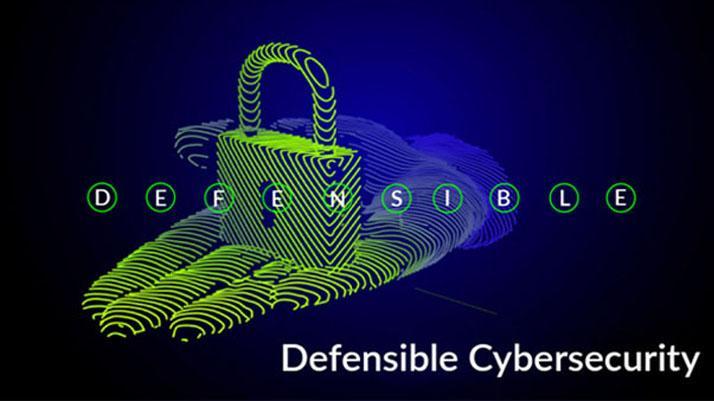
Defensible (de·​fen·​si·​ble\di-ˈfen(t)-sə-bəl) is described as “capable of being defended”. “Defensibility” thus alludes to the ability to remain protected from attack. Cybersecurity should have always been defensible… to be able to adapt to changes, especially continuously changing business intent and risks thereof….

The industry has felt this quite long ago. As early as 1970 a Report of the Defense Science Board Task Force about Security Controls for Computer Systems, noted that providing satisfactory security controls in a computer system is in itself a system design problem. This seems to be true today too. Despite spending billions on cybersecurity, cybersecurity teams are continuously fighting fires because protecting the organization is an asymmetric challenge.  Security Leaders need to protect an increasingly larger number of entry points while the bad guys just have to find just one-way in.

In the aftermath of COVID19, we are looking at a new way of doing business…. Now, there are more and more users outside of the enterprise accessing services than inside… more unmanaged devices connecting to services than managed devices and… more and more internal users are consuming applications delivered from outside of the enterprise network than the inside. Digital transformation is hinged on using the Internet more and more, but the Internet was designed to be flexible and open, not secure. Every mobile phone, cloud application, branch office, IoT and remote employee is an entry point.

It is time for defenders to change the approach.

On May 12, CMS IT Services launched a fresh new approach to cybersecurity – the Defensible Cybersecurity Model, in an industry where there are just too many cybersecurity technologies overlapping in intent and content at the enterprise.

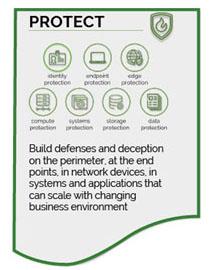
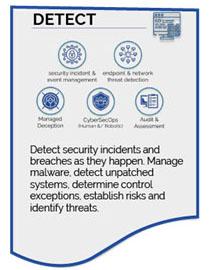
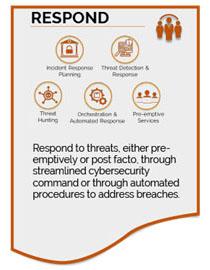
The CMS IT Services Enterprise Cybersecurity Solutions are designed to help enterprises embrace the Defensible Cybersecurity way of ensuring that they can protect their crown jewels through optimized investments in cybersecurity technology and processes, detect deviations, events, incidents, and breaches in their computing infrastructure, and can respond effectively to ensure that the consequences are limited and contained to the extent the leadership desires to, within the boundaries of their risk appetite.

Intricacies of the Protect, Detect and Respond Portfolio

The genesis of the Defensible Cybersecurity model can be traced to2 key papers. The first is the report of the New York Cyber Task Force at Columbia University SIPA, titled “Building a Defensible Cyberspace”, And the second is a physical security concept that was designed to reduce crime by intelligently designing defensible spaces, through Natural Surveillance, Access Control, Territorial Reinforcement, and Maintenance, called as Crime Prevention through Environmental Design (CPTED).

Defensible Cybersecurity is a holistic approach to address cybersecurity challenges, aligned to the context of business, addressing systemic issues, challenges and stakeholder requirements, designed to handle constant change while Consistently improving operational controls, designed to address cybersecurity risks for both traditional & digital businesses and their supply chains.

To learn more about the Defensible Cybersecurity Framework

Director Cybersecurity

Ensure Customer Delight: Automate your Customer-Service Lines with Conversational AI

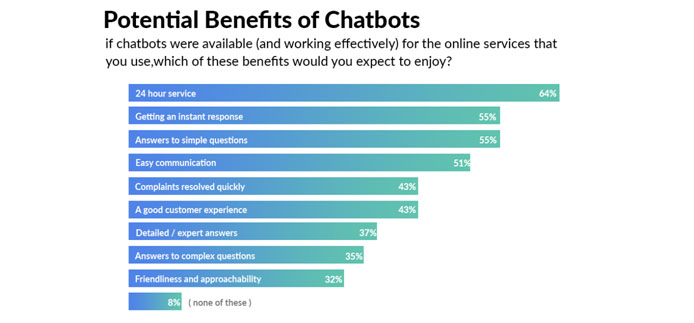
Providing amazing customer service is one of the primary goals of any business. In the current scenario AI Chatbots are turning out to be the safest way to interact with customers. Chatbots allow us to eliminate a fair share of the ‘human’ factor from the interaction chain. Especially for answering standard queries and sharing general or specific information that customers might require. Whether a customer is retained or not is highly dependent on how smooth their initial interaction with the company is and how well they are treated during this crucial step.

Chatbots work along the same lines as a human in terms of communicating with prospects, but it is more apt to say the chatbot works practically the way it is programmed to. Chatbots powered by Artificial Intelligence, do not rely on written process material or videos, it learns from real-time scenarios or the archives of earlier conversations. The way chatbots can stimulate the conversation and keep customers engaged has made them a promising option in the market.

Companies are drawn towards digital services and/or digital platforms today but the apprehensiveness over the loss of existing or potential customers due to unsatisfactory service remains. While most enterprises have more or less accepted the Chatbot trend and are providing a complete digital experience for their customers, some still prefer a human touch or intervention to the transaction.

At times, the communication channel of the chatbot may hit a dead end, and to avoid such situations the most important thing is to have common and critical intents fed to the Bot. But complications could still pop up post ironing all teething issues. The AI Chatbot may be functioning properly but may fail in considering the limits and be unable to deliver information at its best level of proficiency during a customer conversation. At such critical juncture, it is important for a human to take over the conversation to diffuse the situation and avoid the user from taking away a negative experience from the interaction. To avoid such stray experiences, it is necessary to set the communication patterns and expectations, so that users are not let down due to restricted knowledge or competence during communication.

Organizations willing to invest in chatbots need to choose the right platform and have the BRD (Business Requirement Document) ready in hand. They also need to invest time in designing the intents that are recognised by humans and bots. It is also advisable to use a human-agent-based bot, with clear indicators for the agent to understand and pick up the conversation from the bot, to ensure a seamless transition of the customer’s query.


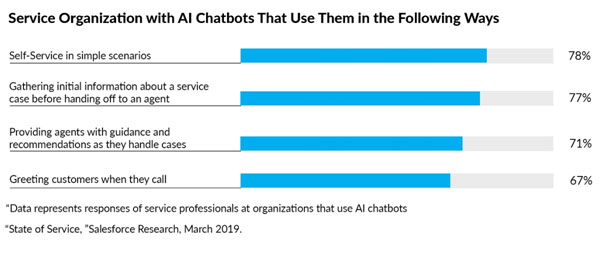
AI Chatbots can efficiently tap into their understanding of automated workflows and knowledge management to ensure the user has a delightful experience where they had a faster resolution of their concerns assisted by technology, in the right way and at the right time. Chatbots have self-service/self-help features that lead users to pointed solutions, web pages and documents instead of deviating them and wasting time. They can also raise a service request ticket on behalf of the customer with all the communication history for the agent to act precisely. They can even book conference rooms and suggest travel itineraries.

So Customer engagement via AI-driven Chatbots is a trend that is here to stay. AI Chatbots are programmed and well-equipped to deal with customers and respond to their queries without human interference. This not only increases efficiency but makes great strides in reducing the workload of customer support teams and at the same time ensures a smooth transition for the customer.

Embrace AI-powered customer acquisition, support and engagement.

Drive business continuity and growth

Head, Automation Practice

Data References:

Top 12 Benefits of Chatbots: Comprehensive Guide [2020 update], MAY 12, 2020 by AI Multiple based on Drift’s 2018 State of Chatbots Report.

https://research.aimultiple.com/chatbot-benefits/

What Is a Chatbot and How Is It Changing Customer Experience? APRIL 25, 2019 by Salesforce Blog.

https://www.salesforce.com/blog/2019/04/what-is-a-chatbot.html

Chatbot Report 2019: Global Trends and Analysis, APRIL 19, 2019 by ChatBot Magazine

https://chatbotsmagazine.com/chatbot-report-2019-global-trends-and-analysis-a487afec05b

4 Evolving Technologies That Are Empowering Chatbots by AITHORITY, JAN 16, 2020

https://www.aithority.com/guest-authors/4-evolving-technologies-that-are-empowering-chatbots/

Two-out-of-three Americans interact with AI chatbots, but we still prefer humans by ZDNET, MAY 18, 2019

https://www.zdnet.com/article/two-out-of-three-americans-interact-with-ai-chatbots-but-we-still-prefer-humans/

Conversational AI Statistics: NLP Chatbots in 2020 by Landbot.io FEB 21,2020

https://landbot.io/blog/conversational-ai-statistics/